Mastering Your 2026 Workflow: The Ultimate Canva Planner
As we look toward the horizon of 2026, the landscape of remote work has matured into something far more nuanced than simply working from a laptop on the couch. Today, successful home-based professionals require systems that bridge the gap between digital agility and physical focus. This is where the 2026 Work from Home Planner Canva enters the conversation, not merely as a set of pages, but as a comprehensive design asset tailored for the modern entrepreneur, marketer, and creative professional. It represents a shift in how we approach editorial design and personal productivity, offering a premium font aesthetic and modern typography that elevates the mundane act of scheduling into a strategic branding exercise.
The Anatomy of a High-Functioning Design Asset
At first glance, the visual appeal of this planner is undeniable. It moves away from the cluttered, chaotic layouts of traditional organizers, embracing a clean, sans serif font foundation that prioritizes white space and readability. This isn't just about looking good; it's about visual hierarchy. The design choices within the 2026 Work from Home Planner Canva Template ensure that your eye is drawn immediately to high-priority tasks, facilitating a flow state that is crucial for deep work.
The personality of the template is professional yet approachable. It avoids the rigidity of corporate stationery while steering clear of overly whimsical, distracting elements. This balance makes it an ideal design asset for a wide array of users. Whether you are a graphic designer managing multiple client revisions, a small business owner tracking inventory, or a content creator plotting a social media calendar, the visual language speaks to competence and clarity. The style leans into minimalism, utilizing creative font pairings that suggest a sophisticated brand identity without demanding attention away from the content itself.
Comprehensive Utility: Beyond the Basic Calendar
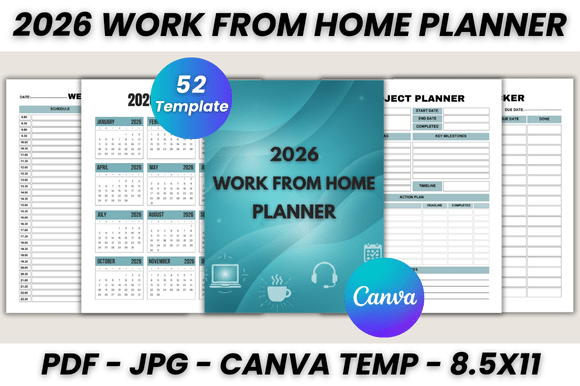
What truly sets this collection apart is the sheer volume of utility packed into its 52 printable pages. It is designed to be a holistic operating system for your year. The structure acknowledges that work-from-home life requires more than just a date book; it requires a central hub for information management.
The inclusion of specific daily breakdowns—Monday through Sunday—allows for granular control over your time, which is essential for those of us juggling side hustles or complex project timelines. However, the planner goes deeper. Consider the practical necessity of the Project Planner and Task Tracker. These pages utilize grid layouts and structured fields that mimic the efficiency of digital dashboards but offer the tactile satisfaction of pen on paper. For the marketer or agency owner, the Meeting Notes section is invaluable, providing a consistent format for capturing action items, ensuring nothing falls through the cracks between Zoom calls.
Furthermore, the inclusion of a Password Tracker and Contact List demonstrates a deep understanding of the remote worker's digital burden. While digital security is paramount, having a physical backup of critical contacts or access codes (stored securely) is a failsafe that many professionals appreciate. The Year At A Glance feature spans four pages, offering a macro view that is essential for long-term strategic planning, while the Today’s Notes section provides the flexibility needed for brainstorming and mind mapping.
Customization: The Power of the Editable Canva File
One of the most significant advantages of the 2026 Work from Home Planner Canva is the Editable Canva Template functionality. This is where the asset transforms from a static document into a dynamic tool for brand identity reinforcement. Canva has democratized design, allowing non-designers to execute professional-grade edits. The template leverages this by allowing full customization of fonts, sizes, colors, and layout styles.
For the entrepreneur or freelancer, this means you can align your internal planning tools with your external marketing materials. Imagine replacing the standard header fonts with your specific brand identity typeface. You can adjust the color palette to match your logo design, turning a generic planner into a bespoke piece of corporate stationery. This level of customization ensures that your planning tool feels like a natural extension of your business, reinforcing brand recognition every time you sit down to organize your week.
The ability to resize is also a critical feature for web design and digital workflows. While the base files come in US Letter size (8.5 x 11) for easy packaging design and printing, the digital nature of the file allows it to be adapted for tablet use or integrated into digital planning apps. The inclusion of bonus JPG files further expands its utility, allowing specific pages—like the 2026 Calendar or Weekly Schedule—to be used as desktop wallpapers or shared on social media graphics to signal availability or project milestones to clients.
Practical Application and Workflow Integration
To get the most out of the 2026 Work from Home Planner, it helps to view it through the lens of workflow integration. The Monthly Planner (January through December) serves as your anchor. I recommend starting each month by reviewing the Important Date section to identify key deadlines or holidays that might impact capacity.
The Weekly Schedule is the tactical layer. For bloggers and publishers, this is where you can map out content pipelines, assigning specific themes to specific days. The Work Planner pages are ideal for breaking down these themes into actionable steps. For instance, a graphic designer might use Tuesday for concepting and Thursday for client presentation prep. By physically writing this out, you create a contract with yourself that is harder to ignore than a digital notification.
The Thank You page, often overlooked, offers a creative opportunity. It can be printed and included with client orders or used as a template for handwritten notes. In an era of automated emails, a physical thank-you note remains a powerful tool for audience engagement and relationship building. This small detail highlights the planner's versatility, bridging the gap between print and digital relationship management.
Evaluating Fit and Longevity
When evaluating whether this planner fits your needs, consider the interplay between structure and flexibility. If you require rigid, time-blocked scheduling down to the minute, you may need to modify the daily layouts. However, for the vast majority of creative professionals, the balance struck here—between structured task lists and open "Today's Notes" areas—is perfect for the fluid nature of creative work.
The visual style is timeless enough to avoid feeling dated by mid-year, yet modern enough to reflect current typography trends. It respects the principles of modern typography by ensuring high contrast and legibility, which reduces eye strain during long planning sessions. Whether you are printing the entire book or using it digitally on a tablet, the resolution and layout remain crisp.
Ultimately, the 2026 Work from Home Planner Canva Template is more than just a scheduler; it is a framework for professional growth. It acknowledges that the tools we use to organize our thoughts influence the quality of our output. By providing a polished, customizable, and comprehensive platform, it empowers you to step into 2026 with a clear strategy, a unified brand presence, and a tangible roadmap to success.